Whalefall: He Accurately Depicted The Horrifying Biological Conditions Inside, Including Caustic Digestive Enzymes
Whalefall Synopsis:
Following the suicide of his domineering father (Josh Brolin), Jay Gardiner (Austin Abrams) embarks on a solo dive off the California coast to recover his father’s remains. The mission turns into a claustrophobic nightmare when Jay is accidentally swallowed whole by a massive sperm whale. Trapped inside the creature's belly with barely an hour of oxygen left, Jay relies on the very survival skills his father taught him, turning a desperate search for closure into an agonizing, high-stakes battle for his own life.
Genre: Thriller
Release Date: In theaters October 16th, 2026
Whalefall Fun Facts: He Accurately Depicted The Horrifying Biological Conditions Inside, Including Caustic Digestive Enzymes
Grounded in Unsettling Real Science:
To make his 2023 bestselling novel Whalefall feel terrifyingly real, author Daniel Kraus took an extraordinary approach to his research. Being eaten alive may sound like pure fiction, but Kraus went to extreme lengths to ground the nightmare in actual science. He even learned to scuba dive himself and spent months consulting with marine biologists, whale anatomists, and veteran divers to make sure every single detail inside the whale was biologically accurate.
Rather than relying on imagination, Kraus engineered the survival struggle using real marine biology. He confirmed that sperm whales are the only creatures on Earth with throat passages large enough to swallow a human whole, and because they don't chew their prey, a diver could theoretically make it to the stomachs intact.
Kraus mapped out the whale’s complex digestive system, detailing how a person would navigate through four distinct, claustrophobic internal chambers. He accurately depicted the horrifying biological conditions inside, including caustic digestive enzymes, pitch-black environments, and the toxic buildup of methane gas that occurs inside a whale’s body.
Kraus treated the inside of the whale like a realistic, living survival map based on real science and turned a wild concept of Whalefall into a deeply grounded, skin-crawling thriller.
Practically Built Whale Chambers:
Sperm whale stomachs are complex, multi-chambered biological systems, and to bring this to life in Whalefall, set designers created large-scale, interconnected rooms filled with thick liquids and moving walls. Hydraulic systems were likely used to contract and churn the sets, simulating the muscular movements of digestion.
Acting in a wet, heavy, continuously moving enclosure imposes real physical stress on the actor naturally. Navigating slippery surfaces, fighting against moving walls, and dealing with actual cold liquids forced Abrams to experience genuine physical strain and disorientation. Instead of acting claustrophobic, he was reacting directly to an actual claustrophobic space. Abrams had to physically fight through the cramped, slimy spaces, making his performance feel authentically intense and claustrophobic.
The One who Suffers the Most on Camera:
Austin Abrams might just be the hardest-working physical actor of his generation or at least the one who suffers the most on camera. Over the years, his career has turned into an endurance test across almost every major horror and thriller subgenre.
In The Walking Dead, he had to dodge flesh-eating zombies; in Scary Stories to Tell in the Dark, he was terrorized by nightmare-inducing witches; and in Resident Evil, he was forced to run for his life from terrifying, mutated monsters. Now, he takes that physical punishment to a whole new level in Whalefall, where his character faces the ultimate survival challenge: being swallowed whole and digested alive by a giant sea monster.
Directed by a Sci-Fi Thriller Mastermind:
Whalefall is helmed by filmmaker Brian Duffield, a director known for making high-concept genre stories feel deeply personal and intense. Moviegoers will likely recognize him from No One Will Save You, his standalone sci-fi thriller that took audiences by storm by telling a terrifying alien invasion story almost completely without spoken dialogue.
With No One Will Save You, Duffield proved he can keep audiences on the edge of their seats through pure visual craft and physical performance rather than long dialogue scenes. Duffield brings that same flair for high-stakes tension to Whalefall, the exact skill set crucial for a movie set inside the silent, dark, and suffocating belly of an ocean giant.
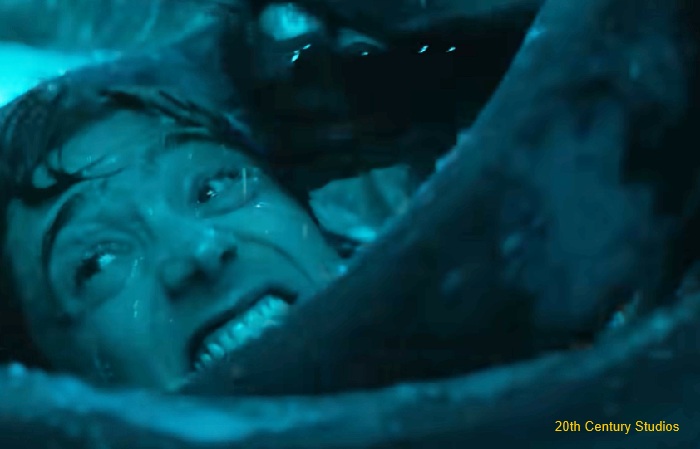
Whalefall Review: Jay Has To Navigate Through The Horrific Remains Of Pre-Digested Giant Squid, Adding A Sickening Sense Of Realism To His Nightmare
Based on Daniel Kraus’s popular novel, Whalefall is a gripping thriller brought to life by director Brian Duffield (known for No One Will Save You). The film delivers a unique blend of heart-pounding survival action and emotional storytelling. The story follows a deep-sea diver who finds himself trapped in the ultimate nightmare; he is swallowed whole by a giant sperm whale. With only about 60 minutes of oxygen left in his tank, he faces a brutal, claustrophobic battle to escape before time runs out.
The story is deeply grounded in a moving family drama that explores loss, grief, and forgiveness. As he fights for his life inside the ocean's greatest predator, he is also forced to confront his painful past and the memory of his late father. Whalefall isn't just a brutal survival movie; it's a surprisingly touching story about human connection, overcoming trauma, and refusing to give up when all hope seems lost.
At its core, the film Whalefall revolves around Jay Gardiner (Austin Abrams), a young diver who is carrying a heavy emotional burden. Jay is haunted by deep feelings of guilt and anger following the tragic suicide of his father, Mitt (Josh Brolin). Mitt was a legendary local diver known for his tough personality, but his complicated past left behind a strained relationship with his son.
Unable to move on from his father's sudden death, Jay feels an overwhelming need for closure. He is determined to search the ocean floor and retrieve his father’s remains so he can finally bring him home. What begins as a personal act of grief quickly spirals into an unbelievable fight for survival when Jay's dive goes terribly wrong.
A giant squid, fighting desperately to escape a hunting sperm whale, thrashes wildly and entangles Jay in the underwater chaos. Before he can break free, the massive 60-ton whale opens its jaws and swallows both Jay and the squid whole. Suddenly, Jay finds himself inside the terrifying depths of the whale’s stomach, trapped in a pitch-black, suffocating chamber of muscle, tissue, and stomach acid.
To get out alive, he must manage his remaining oxygen supply down to the last breath. He has to constantly move to avoid being burned or digested by powerful stomach acids. He must use his scuba equipment in clever, unintended ways to solve life-or-death physical obstacles inside the beast. Most importantly, he is forced to draw on the tough, demanding survival lessons his late father drilled into him, the very training Jay once resented now becomes his only lifeline.
Austin Abrams carries nearly the entire movie on his shoulders in Whalefall; for most of the film, he is the only actor on screen, stuck in an intensely claustrophobic space, squeezed between the pulsating inner walls of a whale and covered in thick gastric slime. Abrams delivers a raw, physically exhausting performance that keeps viewers hooked from start to finish. He throws his whole body into the role; you can feel the exhaustion, pain, and claustrophobia in every movement as he struggles through the tight, pitch-black space.
He shows authentic terror but also the sharp, calculating survival instincts of a trained diver trying to solve one deadly problem at a time. Performing alone in a single, bizarre setting for an entire movie is a massive challenge for any actor. Abrams pulls it off brilliantly, grounding a wild concept in deep emotional reality in Whalefall.
Even though his character has passed away, Josh Brolin delivers a standout performance that leaves a huge mark on the movie. He appears throughout the film in memory flashbacks and intense, dream-like hallucinations triggered by Jay’s fading oxygen levels. Brolin plays Mitt the larger-than-life father with a compelling mix of rugged charisma, flawed tough love, and fierce intensity in Whalefall.
Yet Brolin brings enough warmth and humanity to the role that you understand both Jay’s anger toward him and his deep love for him. As oxygen runs low and Jay begins to lose consciousness, his conversations with his hallucinated father force him to confront his past trauma. Ultimately, Jay isn't just fighting the whale to stay alive; he is fighting to make peace with his father's memory. That deep emotional connection gives every scene inside the monster real weight and purpose.
Director Brian Duffield keeps the movie moving at a relentless pace, never letting the audience catch their breath. He doesn't shy away from the gross or uncomfortable details; he fully leans into the stomach-churning reality of what being trapped inside a giant sea creature would actually feel like in Whalefall.
You can practically feel the suffocating pressure as Jay struggles to crawl through narrow, muscle-bound passageways inside the throat and esophagus. Every move is a life-or-death gamble as he carefully dodges pools of harsh digestive acid that threaten to eat through his suit and skin. Jay has to navigate through the horrific remains of pre-digested giant squid, adding a sickening sense of realism to his nightmare.
Duffield's direction creates an intensely physical experience for the audience. You feel the claustrophobia, smell the stench, and wince at every agonizing obstacle in his way.
The movie’s sound design is absolutely incredible in Whalefall, doing a massive amount of heavy lifting to bring the story to life. The film uses realistic, spine-chilling sound effects to turn the inside of the sperm whale into a living, breathing character of its own.
Audiences hear every terrifying detail from the wet sloshing of stomach fluids to the sickening crunch of bones being crushed as the whale digests its food. The faint, muffled thud-thud of the massive creature’s heartbeat rings out continuously, reminding Jay (and the audience) that he is trapped inside a living giant. The sound team creates a dense, inescapable wall of audio that surrounds the audience, making you feel as though you are trapped in that dark, squelching space right alongside the main character.
Whalefall is a bold, wildly entertaining survival movie that completely delivers on its crazy promise. The non-stop suspense and eye-popping visual design create an edge-of-your-seat theater experience that keeps your heart racing throughout the entire film.
Austin Abrams gives a grueling, highly physical performance that grounds the absurd setup in raw human emotion and genuine desperation. Director Brian Duffield elevates what could have been a basic monster movie into a creative, nerve-wracking masterpiece by focusing on realistic detail and emotional depth. Whalefall is a memorable, intense, and deeply moving cinematic ride that will keep you holding your breath until the very last frame.
You Might Also Like...
Now You See Me Now You Don't Trailer, Fun Facts & Review
Now You See Me Now You Don't Synopsis: The Four Horsemen return to team up with a new generation of illusionists who are all tasked by the mythical secret
The Housemaid Trailer, Fun Facts & Review
The Housemaid Synopsis: Desperate for a fresh start, Millie Calloway (Sydney Sweeney), a young woman with a troubled past, becomes the live-in housemaid for the
Eden Trailer, Fun Facts & Review
Eden Synopsis: Eden tells a grim true story about a group of unhappy outsiders trying to build a perfect community on a deserted island in the Galápagos during