The Uprising: Greengrass Is Bringing That Same Intense, High-Energy Camera Style To His New Movie
The Uprising Synopsis:
Set against the backdrop of plague-ravaged 14th-century England, commoner Ploughman (Andrew Garfield) and radical preacher John Ball (Jamie Bell) lead tens of thousands of impoverished peasants in a violent march toward London to confront the young King Richard II. Sparked by crushing war taxes and systemic government corruption, their localized protest rapidly escalates into a brutal medieval class war, forcing the English monarchy to face a desperate, armed struggle for the rights and freedom of the working class.
Genre: Action, Drama, War
Release Date: In theaters September 11th, 2026
The Uprising Fun Facts: Greengrass Is Bringing That Same Intense, High-Energy Camera Style To His New Movie
Produced by Horror Titan Jason Blum:
Most moviegoers know Jason Blum as the king of low-budget horror hits like Paranormal Activity, Insidious, and M3GAN. But with this new project, The Uprising, the famous producer is stepping way outside his comfort zone. By teaming up with director Paul Greengrass, Blum is trading jump scares for a massive historical war drama, a rare move for a studio usually known for haunted houses and creepy dolls.
A Signature Shaky-Cam Goes Medieval:
Director Paul Greengrass completely changed the game for modern action movies with The Bourne Supremacy and The Bourne Ultimatum. He made audiences feel like they were right in the middle of the fight using his signature shaky-cam style, a fast-paced, handheld shooting technique that feels more like a raw documentary than a polished Hollywood film. Now, Greengrass is bringing that same intense, high-energy camera style to his new movie, The Uprising. Set during the English Peasants' Revolt of 1381, the film promises medieval battle scenes that toss out the slow, rigid style of traditional history movies in favor of pure, pulse-pounding chaos.
Andrew Garfield Plays Real-Life Rebel:
Andrew Garfield stars as Wat Tyler in The Uprising, one of the most remarkable rebel figures in British history. Tyler was the driving force behind the English Peasants' Revolt of 1381, a massive, bloody uprising born out of pure desperation. In the decades following the Black Death, which had wiped out nearly half of Europe's population, England's working class faced relentless hardship. When the government tried to squeeze even more money out of struggling families through oppressive new taxes, Tyler stepped up. He organized a crowd of tens of thousands of angry commoners, leading a historic march to the heart of London to confront the young King Richard II directly and fight for their basic freedom.
A Very Young Intimidating Monarch:
King Richard II was an intimidating, absolute ruler with the full power of the English throne behind him. But in reality, when Wat Tyler and his army of tens of thousands arrived at the gates of London in 1381, the king was actually just a 14-year-old child. The Uprising stays true to this fascinating piece of real history, setting up a striking dynamic. It puts Andrew Garfield’s seasoned, weary rebel leader directly across from a child wearing a crown, a boy swallowed by royal gold, hidden behind fortress walls, and pulled by the strings of greedy, scheming advisors. That contrast creates a wild power dynamic, a hardened working-class man demanding justice from a pampered child who holds the power of life and death over an entire nation.
Thousands of Extras in Germany:
Even though the story takes place in the rolling countryside of medieval England, the crew actually filmed key parts of the movie across Bavaria and Franconia in Germany. To truly capture the massive scale of thousands of angry peasants marching on London, the filmmakers skipped CGI shortcuts whenever possible. Instead, they brought in a staggering 5,000 live extras to fill the screen. Shooting on location at real, centuries-old castles and expansive open-air history museums, the production managed to recreate the authentic, gritty look of a full-scale 14th-century rebellion in The Uprising.
The Uprising Review: Every Battle Feels Claustrophobic, Brutal, And Terrifyingly Real
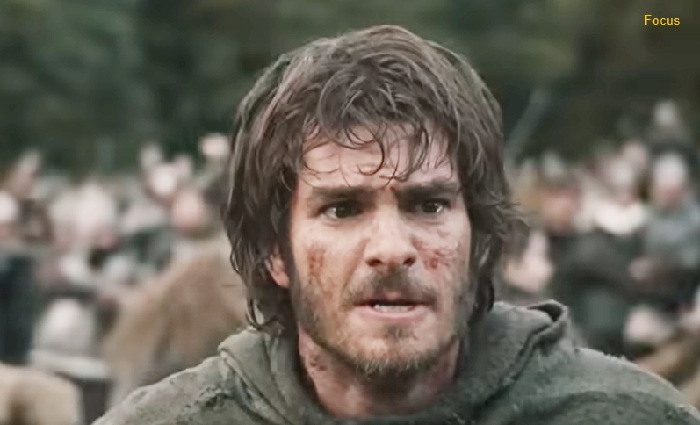
The Uprising brings director Paul Greengrass’s signature fast-paced, realistic filmmaking style to medieval England. Set during the reign of King Richard II, the historical movie centers on the Peasants' Revolt of 1381, a massive rebellion triggered by extreme government oppression and unfair taxes. Andrew Garfield stars as Ploughman, an ordinary farmer who helps lead the common people in their fight for freedom and survival.
Greengrass uses dynamic, documentary-like camera work to throw viewers straight into the heart of the action. The film balances raw, intense combat scenes with a deep exploration of the timeless struggle between the working class and the ruling elite.
Set in the dark aftermath of a catastrophic plague that wiped out half of England’s population, the story centers on Ploughman (Andrew Garfield), a grieving widower and humble farmer. When the royal council of King Richard II imposes cruel, unfair taxes to line the pockets of wealthy oligarchs, Ploughman reaches his breaking point. In a desperate act of defiance, he violently strikes back against a local tax collector with a single action that ignites a widespread rebellion, causing the uprising.
Ploughman joins forces with two other key figures, John Ball (Jamie Bell) and Wat Tyler (Cosmo Jarvis). John Ball is a radical preacher who fights for social equality among the classes, and Wat Tyler is a hardened former soldier who provides strategic leadership and muscle to the cause. Together, they lead a growing army of fed-up laborers and working-class families on a historic march toward London, determined to confront their teenage king and demand justice.
Andrew Garfield delivers a deeply grounded, emotional performance as a reluctant leader struggling to hold a chaotic rebellion together in The Uprising. Rather than playing a larger-than-life hero, he grounds the character in real human vulnerability. Garfield brings subtle, quiet intensity to tense negotiation scenes with royal authorities, while tapping into raw, burning rage during brutal battlefield encounters.
Director Paul Greengrass and cinematographer Pål Ulvik Rokseth deliberately avoid glossy Hollywood visuals, choosing instead a raw, stripped-down look for The Uprising. Filmed with an unvarnished realism, the movie captures medieval England as a cold, oppressive environment. The handheld camera work moves constantly through grey skies, knee-deep mud, and weather-worn wooden structures. This grounded visual approach makes the harsh realities of peasant life feel uncomfortably real and immediate, pulling viewers directly into the grime and struggle of the period.
Greengrass applies the same fast-paced, immersive camera movement that made his Jason Bourne movies famous directly to medieval warfare in The Uprising. Instead of smooth, staged Hollywood action, the film uses constant handheld camera work to drop viewers right into the middle of the chaos. Swords clash, armor rattles, and bodies collide only inches from the lens. Greengrass avoids wide, clean shots in favor of tight angles and rapid movement; every battle feels claustrophobic, brutal, and terrifyingly real.
The film’s script holds nothing back when depicting the harsh realities of state control and corporate-style greed. By directly confronting systemic corruption, including predatory high taxes, forced wage cuts, and political trickery, it forces viewers to notice how little human nature and power dynamics have changed over seven centuries. Although the movie takes place in the 14th century, its central conflict feels intensely modern. The story mirrors modern struggles around class inequality, economic pressure on working-class families, and deep-seated public frustration with self-serving elites.
Greengrass makes his core themes unmistakably clear; throughout the film in The Uprising, he constantly contrasts the absurd, luxurious wealth of the royal ruling class with the explosive, desperate rage of the working people. Greengrass also highlights the dark side of mass movements, demonstrating how easily genuine anger can slip into terrifying chaos, mob violence, and unpredictable destruction. It serves as a cautionary look at how populist uprisings can be manipulated by opportunistic figures or quickly spiral far beyond the control of those who started them.
Young actor Woody Norman turns in a strong, compelling performance as the insecure and deceitful teenage monarch, King Richard II. He effectively captures the young king's internal conflict, showing a boy caught between his own cowardice and the massive burden of his crown in The Uprising.
However, the film stumbles when it comes to the advisors and noblemen surrounding him. The royal inner circle is written with far less emotional depth; rather than feeling like complex historical figures driven by political strategy, they are depicted as aristocrats who exist purely to be greedy and corrupt. This one-dimensional portrayal robs the palace scenes of emotional depth, making the government side of the conflict feel flat compared to the rich, human story on the ground.
While Andrew Garfield brings rich depth to his central role in The Uprising, the surrounding rebel figures suffer from a lack of character development. Key allies like the radical priest John Ball (Jamie Bell) and the hardened warrior Wat Tyler (Cosmo Jarvis) are often written as simplified historical figures.
These characters lack the depth of human beings with personal stories and lives; instead, they are largely defined by single traits, the extreme idealist or the brutal enforcer. When the film treats these key figures from an ideological point of view rather than as real people, it misses an opportunity to explore the complex personal bonds and clashing motives that truly drove the movement.
The Uprising is an ambitious, uncompromising historical epic that chooses raw realism and harsh class warfare over typical Hollywood heroism. Instead of glorifying battle, the movie focuses on the crushing reality of government oppression, economic exploitation, and working-class anger.
While a few flaws in the script, such as thin supporting character development, keep the film from reaching true masterpiece status, it remains a powerful watch. Garfield’s commanding performance paired with Greengrass’s intense, realistic direction elevates the story, making it one of the most powerful and relevant historical movies in years.
You Might Also Like...
In the Grey: They Take On Jobs That Are Too Dirty For The Government
In the Grey Synopsis: Follow a trio of elite specialists who operate in the shadowy legal vacuum between the law and the criminal underworld. When a ruthless
From the World of John Wick Ballerina Trailer, Fun Facts, Gossip & Rev
From the World of John Wick Ballerina Synopsis: The story begins with Eve Macarro (Ana de Armas) training in the assassin traditions of the Ruska Roma as she
Mutiny: Brutal Close-Quarters Combat Where Every Punch, Dodge, And
Mutiny Synopsis: Framed for the brutal murder of his billionaire boss, former Special Forces operative Cole Reed (Jason Statham) goes on the run as an internati