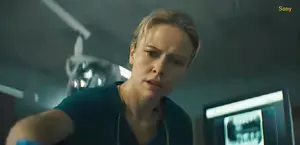
Passenger: Your Safe Haven On Wheels Can Quickly Become A Death Trap
Passenger Synopsis:
A young couple’s cross-country van trip descends into a relentless nightmare after they witness a gruesome highway accident. They soon discover that an ancient, shapeshifting demonic entity has latched onto their vehicle, forcing them into a claustrophobic battle for survival across the American landscape. Trapped within the confines of their van and unable to outrun the curse, the duo must find a way to break the entity’s hold before the miles run out and it claims their souls.
Genre: Horror
Release Date: In theaters May 22nd, 2026
Passenger Fun Facts: Your Safe Haven On Wheels Can Quickly Become A Death Trap
The Real-World Scares:
The promotional team behind the new film is using a chilling tactic to grab people's attention; they are blending fiction with real-world true crime vibes. Instead of just showing scary clips, the advertisements lead with unsettling statistics that try to spook the viewers. In the trailers, the film highlights that every year, roughly 130 million people set out on road trips. Out of those millions, the ads claim that approximately 15,400 people simply vanish and are never heard from again. By leading with these figures, the campaign positions the movie, Passenger, as the terrifying explanation for these real-life disappearances. It’s a clever way to make the audience feel that the horror on screen could actually happen to them the next time they pull onto a lonely highway.
Suffocating Horror:
After his work on the large-scale vampire epic The Last Voyage of the Demeter, director André Øvredal is shifting gears. With his new film, Passenger, he is returning to the contained horror in which most of the film takes place within the claustrophobic confines of the couple's van, heightening the tension. By focusing on just two people in a small space, every breath and every sense of fear feels amplified. The movie takes aim at the peaceful, adventurous, cross-country van trip and flips the script in Passenger. The film explores the idea that your safe haven on wheels can quickly become a death trap when you realize an intruder is just inches away on the other side of the glass. It transforms the cozy, nomadic lifestyle into a suffocating, metal-box prison.
A Focus on Real Monster:
One of the most exciting things for horror fans is director André Øvredal’s commitment to practical effects. Øvredal prefers a more old-school, hands-on approach over CGI. The Passenger entity is brought to life by actor Joseph Lopez. By using a real actor in a physical suit or makeup, the monster has a physical presence and feels more real. When it slams against the van or moves in the shadows, it looks and feels like it’s actually there in the room with the actors. By choosing to use a physical performer instead of a digital effect, the film aims to tap into a more primal kind of fear. The Passenger entity is a tangible, breathing threat that shares the same cramped space as the couple, making the contained setting of the van feel even more dangerous.
The Memorial Day Boost:
Paramount Pictures has officially shifted the debut of the Passenger, moving it up from its original May 29th slot to a new premiere date of May 22nd, 2026. By moving the date forward one week, the studio is positioning the movie to launch right at the start of the Memorial Day holiday weekend. This will give the film a head start, allowing it to capture a larger audience who are looking for a horror thrill over their long break. The original date would have put the film in direct competition with Backrooms, a movie that has generated massive amounts of online hype and is expected to dominate the horror genre. By hitting theaters a week earlier, they can build up word-of-mouth momentum before other major blockbusters arrive to crowd the marketplace.
Passenger Review: There Is A Bizarre, Creepy Contrast Between What You Are Hearing And What You Are Seeing
If you love a good scare, you’ve probably already crossed paths with director André Øvredal. He has quietly become one of the most reliable filmmakers in modern horror. What makes Øvredal so good is his ability to turn everyday spaces into traps. He is an expert at playing with shadows and making a room feel like it’s closing in on you. We saw him do this brilliantly in his recent movie, The Last Voyage of the Demeter, where he trapped a helpless crew on a dark, stormy ship at sea with Dracula. Now, he is bringing that same terrifying energy to his latest film, Passenger.
But this time, instead of trapping his characters inside a creaky ship, Øvredal is taking his signature style out onto the open highway in Passenger. The movie attempts a unique mashup, blending the freedom of the nomadic, road-trip lifestyle with the suffocating dread of supernatural horror. By taking the fear out of the shadows and putting it behind the wheel, Øvredal is proving once again that he knows exactly how to keep audiences on the edge of their seats, no matter the setting.
The story follows Tyler and Maddie, a young couple who decide to pack up their entire lives to live out of a fully customized passenger van and hit the open road to embrace a nomadic lifestyle. While cruising down a pitch-black, isolated highway, Tyler and Maddie witness a horrific car crash. They pull over to the side of the road and rush toward the wreckage to help. By doing so, they accidentally cross paths with The Passenger, a decaying, demonic entity that preys on unsuspecting drivers.
The passenger is a relentless supernatural force that hitches a ride with drivers, latching onto them and refusing to let go. Once it marks its prey, there is no escaping it. The entity stalks the couple endlessly, turning the vast, open highway into a claustrophobic trap. Tyler and Maddie quickly realize that their dream van has become a moving target, and the open road offers absolutely nowhere to hide.
One of the most terrifying moments in Passenger takes place in a completely ordinary setting, a late-night parking lot. The scene isolates Maddie, leaving her completely alone in a vast, empty lot surrounded by darkness. Director André Øvredal uses the layout of the parking lot like a weapon against the audience's nerves. Instead of using cheap jump scares, he uses the physical space to create dread and a slow-burning sense of anxiety.
By showing just how far away help is, the empty space feels less like freedom and more like a trap. Every flickering light pole and dark corner becomes a place where something could be hiding. You expect to see danger coming from a mile away in this open lot, but nothing happens immediately. The director plays on this anticipation, stretching out the silence until your mind starts playing tricks on you. It’s a sequence that takes a situation we’ve all experienced before, walking alone to a car in the dark, and amplifies it into pure, relatable horror. Every shadow matters, and the wait for something to happen is almost worse than the scare itself.
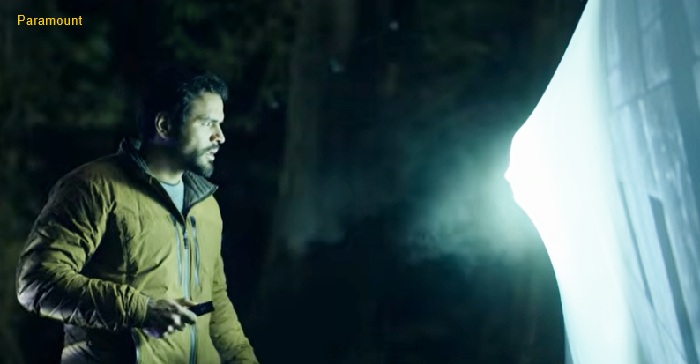
Every great horror movie has that moment where the characters hear a strange noise in the dark and shine a flashlight into the trees. It’s a classic setup, but Passenger turns it completely on its head with a brilliant, modern twist. Instead of a standard flashlight, Tyler and Maddie use a portable consumer movie projector to see what is lurking in the dark. They aim the projector straight into the dense woods, while the lighthearted, romantic classic Roman Holiday is beaming directly onto the trees.
There is a bizarre, creepy contrast between what you are hearing and what you are seeing. While the cheerful, glamorous sounds of an old Hollywood romance echo through the night, a real-life horror story is unfolding in the shadows. Because a projector light constantly flickers and shifts as the movie plays, it creates a shadowy effect against the leaves and branches. Every time the frame changes, the shadows warp, making it incredibly hard to tell if the trees are moving or if something is crawling between them.
In Passenger, the entity is brought to life under a heavy layer of practical latex prosthetics and incredible physical acting by Joseph Lopez. He has a rich background in creature performance, a highly specialized type of acting where performers use their entire bodies to portray monsters. His creepiness relies entirely on absolute stillness, standing completely frozen on the side of the road like a statue followed by sudden, deeply disturbing shifts in posture. This type of physical performance brings a heavy, lifelike reality to the screen. It is a terrifying, tangible presence that CGI simply cannot replicate. When you see him standing under a flickering street lamp, your brain instantly knows a real person is in that space, making the nightmare feel all too real.
At the heart of any good horror movie is a couple you actually want to root for. In Passenger, the natural, easygoing chemistry between lead actors Jacob Scipio and Lou Llobell is the absolute glue holding the film together. Scipio and Llobell are so charming and believable together that they keep you locked in, making you care about their safety even when the pacing slows to a crawl during the halfway point in the movie.
Where the actors hit a major speed bump, however, is in the movie's script. While they are great at playing a real couple, they occasionally struggle with the actual dialogue they are forced to say out loud. At certain points, the story stalls so the characters can explain the rules of the demon, how it hunts, what it wants, and how to stop it. When forced to deliver these massive chunks of unnatural information, the actors' performances occasionally become stiff. It feels less like two terrified people having a real conversation and more like actors reading lines from an instruction manual.
Interestingly, Scipio and Llobell are at their absolute best when they aren't speaking at all. They excel at silent acting, using the heavy atmosphere inside their passenger van to do the heavy lifting. The most intense moments come from the quiet, panicked glances they share across the van's dashboard. A single terrified look between them communicates more panic and dread than any line of dialogue ever could.
Despite some of the uninspired script in the midsection, Passenger delivers a stylish, practical monster movie with unforgettable sequences and a genuinely gripping atmosphere. It is a highly effective piece of highway horror that proves Øvredal does not need to trap the characters in the enclosed settings to terrify the audience. He terrifies the audience just as easily with an open road trip setting in the middle of nowhere in The Passenger.
You Might Also Like...
Whistle: In A Stunning And Gory Sequence, His Body Breaks And Twists
Whistle Synopsis: A group of high school students discover and blow an ancient, cursed Aztec Death Whistle, which tragically unleashes a horrifying curse that
Insidious Out of the Further: Even From Beyond The Grave, The Movie
Insidious Out of the Further Synopsis: Gemma, a young single mother who discovers she possesses the rare ability to astral project into the fog-shrouded
Five Nights at Freddy's 2 Trailer, Fun Facts & Review
Five Nights at Freddy's 2 Synopsis: One year after the horrifying events at Freddy Fazbear's Pizza, Mike (Josh Hutcherson) and Vanessa (Elizabeth Lail) have